

Now Reading: Baby Dragon Hatchling (BDH): The Architecture That Makes Static LLMs Obsolete
-
01
Baby Dragon Hatchling (BDH): The Architecture That Makes Static LLMs Obsolete
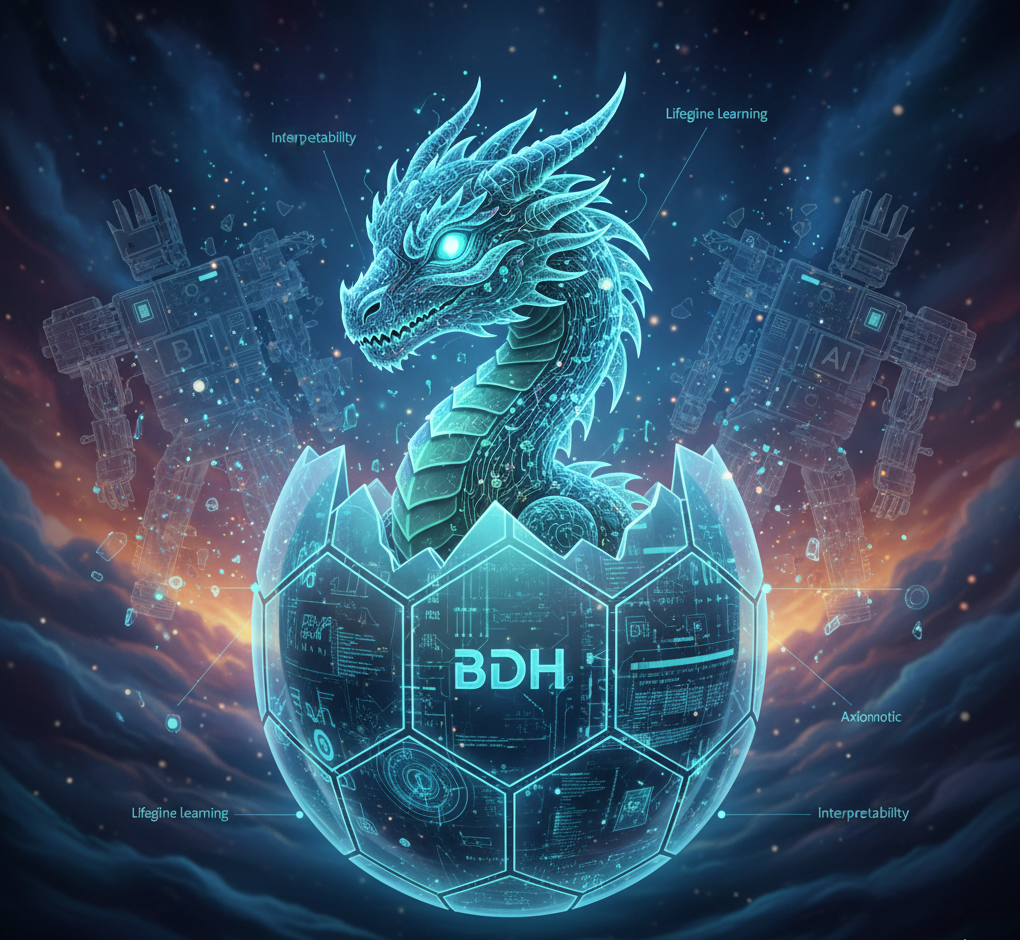
Baby Dragon Hatchling (BDH): The Architecture That Makes Static LLMs Obsolete
Large Language Models changed how we use AI. However, they remain static systems that cannot grow, adapt, or reason across long periods. They learn correlations inside a frozen dataset and stop evolving the moment training ends. As a result, their understanding becomes stale and brittle as the world changes. This limitation is known as Generalization Over Time.
BDH, or Baby Dragon Hatchling, is a new architecture inspired by biological learning. It introduces continuous adaptation, stable long-term memory, and modular reasoning. It also avoids the heavy scaling demands that define transformer models. With BDH, AI begins to behave like a living system that learns through experience instead of a tool locked in place.
This deep dive explains how BDH works and why it represents the future of adaptive intelligence. It connects BDH to the research direction seen in OpenAI’s real time reasoning architecture and Meta’s SPICE self improving reasoning system. Together these innovations point toward an era in which AI systems think, adapt, and understand across weeks or months instead of minutes.
1. What Is the Baby Dragon Hatchling Architecture
BDH is a shift away from large static networks. It aims to recreate three properties found in biological brains.
1. Plasticity
The system can change specific connections when new information appears. This allows learning to happen gradually.
2. Monosemanticity
Each unit represents a single concept. This makes reasoning more interpretable and reduces ambiguity.
3. Slow and stable memory
Knowledge is reinforced over time. The model retains old concepts without overwriting them when new ones are learned.
Together these traits give BDH the ability to grow. Instead of retraining on massive datasets, BDH modifies itself continuously.
2. Why Transformers Cannot Learn Over Time
Transformers are powerful, but they contain structural weaknesses that prevent lifelong learning.
2.1 Transformers forget when new data arrives
Updating a transformer requires expensive fine tuning. When the model is trained on new data, it often overwrites earlier knowledge. This is catastrophic forgetting.
2.2 Transformers cannot generalize across long periods
A transformer learns from a fixed dataset. It does not interact with reality or adapt based on feedback. Eventually, its reasoning becomes outdated.
2.3 Transformers scale inefficiently
Better performance requires more parameters. This increases cost and energy usage.
2.4 Transformer neurons blend many concepts together
A single neuron represents thousands of ideas. This creates a black box that is hard to interpret or trust.
BDH solves these issues with a design that emphasizes adaptability and modular growth.
3. BDH’s Core Innovations
3.1 Continuous Learning Through Hebbian Plasticity
Traditional LLMs store knowledge through global weight updates. BDH stores knowledge through local rules. Hebbian plasticity strengthens connections when two units activate together. This forms stable memory patterns that evolve naturally.
As a result, BDH can learn continuously. It does not require retraining. It does not forget old information when new knowledge appears. This makes BDH suitable for real-time agents, robotics, smart environments, and any system operating in changing conditions.
This behavior also reflects token efficient model design principles that reduce compute cost.
3.2 Axiomatic Interpretability Through Monosemantic Units
Transformers mix many meanings inside individual neurons. BDH does the opposite. Each unit encodes one concept. This allows developers and regulators to inspect exactly why a decision was made.
This explains why BDH is valuable in sectors that require clear reasoning.
- Finance
- Medical decisions
- Law
- Safety and compliance
Monosemantic units create transparent reasoning chains. This matches the direction of Meta’s SPICE self improving reasoning system, which also seeks structured logic.
3.3 Linear Scaling That Enables Wider Access to Advanced AI
Transformers scale through parameter count. BDH scales through structure. The model grows by creating new conceptual units rather than increasing global size. This reduces costs and makes advanced AI accessible to smaller teams.
BDH improves:
- Efficiency
- Energy usage
- Training cost
- Accessibility
- Safety
It provides high performance without hyperscale infrastructure.
4. How BDH Works Internally
BDH combines three subsystems that work together.
4.1 Fast Pathway
Handles immediate reasoning, pattern recognition, and rapid responses.
4.2 Slow Pathway
Stores long-term knowledge through repeated reinforcement. Knowledge becomes more stable over time.
4.3 Structural Growth
Creates new units when the system encounters a concept it cannot represent. This allows BDH to expand naturally as it learns.
Together these pathways allow BDH to evolve and reorganize itself. It behaves more like a dynamic biological system than a rigid mathematical graph.
5. The Core Problem BDH Solves
Traditional transformers treat every request as isolated. They do not learn from ongoing interaction. BDH introduces a system that grows continuously.
Transformers face these limitations:
- Static weights stop models from adapting
- No long-term memory
- Catastrophic forgetting
- High compute usage
- No continuity or personalization
BDH replaces these flaws with adaptive learning and persistent memory.
6. BDH’s Technical Architecture
BDH introduces a multi-cell structure inspired by how the cortex organizes knowledge.
6.1 Growing Neural Cells
Instead of one large frozen network, BDH uses many lightweight cells.
Each cell can:
- Store a skill
- Retain a memory
- Update independently
- Collaborate with nearby cells
This resembles neurogenesis and prevents forgetting.
6.2 Dynamic Routing
BDH does not activate the full network for each request. Instead, it routes the input to the most relevant cells.
This improves performance through:
- Lower compute cost
- Better specialization
- Task-specific accuracy
This is similar to a Mixture of Experts model but implemented at the structural level.
6.3 Continuous Adaptation Loop
BDH introduces Generalization Over Time.
The model:
- Observes long-term patterns
- Updates the correct cells
- Strengthens stable concepts
- Reduces noise or outdated memories
This is the first architecture aimed at lifelong learning in real-world deployment.
7. BDH vs Transformers: Architectural Differences
| Feature | Transformer | BDH |
|---|---|---|
| Weight updates | Expensive retraining | Local lightweight updates |
| Long-term memory | None | Persistent multi-cell memory |
| Adaptation | Frozen after training | Continuous |
| Efficiency | Full-network compute | Dynamic routing |
| Knowledge retention | Easily overwritten | Stable over time |
| Personalization | External RAG hacks | Built-in memory |
BDH removes the need for RAG pipelines, embeddings management, and frequent fine tuning. It merges model, memory, and retriever into one adaptive system.
8. Real-World Use Cases
8.1 Personal Assistants
A BDH assistant remembers:
- Your workflow
- Your corrections
- Your domain knowledge
- Your habits
It learns like a real partner instead of resetting every day.
8.2 Autonomous Agents
Static LLMs cannot learn from recent actions. BDH can.
This enables:
- Research agents
- Simulated agents
- Multi-step planning
- Adaptive strategies
8.3 Enterprise Systems
BDH is ideal for companies that change quickly.
- Policy updates
- Real-time knowledge shifts
- Regulatory environments
BDH can update itself internally without destabilizing the entire model.
8.4 Safety and Explainability
Each BDH cell is traceable.
This improves:
- Auditing
- Safety reviews
- Decision transparency
9. The Future: BDH as the Successor to Transformers
The transformer unlocked scale.
BDH unlocks adaptation.
The industry has relied on:
- RAG pipelines
- Embeddings databases
- Retrieval agents
- Memory add-ons
All of these exist because transformers cannot learn over time.
BDH removes these layers.
It unifies:
- Model
- Memory
- Adaption
- Retrieval
AI becomes a single living architecture that grows.
People Also Ask: Key Questions Answered
How does BDH learn over time
BDH updates its internal cells gradually using plasticity rules. Each memory is stored in an isolated unit, so old knowledge is preserved while new knowledge is added.
Is BDH biologically inspired
Yes. BDH uses slow consolidation, selective activation, and modular concepts. This creates stable memory patterns and continuous learning.
Can BDH work with existing LLMs
Yes. BDH can act as an adaptive memory layer on top of static LLMs. Over time it can replace most transformer functions.
Is BDH more scalable
BDH improves through structure instead of massive parameter counts. This reduces cost while supporting growth.
Why is BDH better for agents
BDH remembers past actions, updates strategies, and adapts to new conditions. This is critical for long-horizon tasks.
Frequently Asked Questions (SEO Optimized)
What is BDH
BDH stands for Baby Dragon Hatchling. It is a new architecture for adaptive, lifelong learning AI.
Why is BDH different from transformers
Transformers cannot learn after training. BDH learns continuously without forgetting.
What is monosemanticity
It means each BDH unit represents only one concept. This improves interpretability and safety.
Is BDH open-source
Several BDH-inspired projects are emerging in the open-source community.
Where can BDH be applied
BDH is useful in assistants, enterprise tools, robotics, research, and safety-critical systems.
Conclusion: BDH Represents a New Stage of Intelligence
BDH marks the beginning of adaptive AI. Transformers gave us scale, but BDH introduces growth. It provides lifelong learning, stable memory, transparent reasoning, and efficient scaling. As a result, it allows AI systems to improve through experience.
This is the direction the field is moving toward. AI is no longer static. It is becoming a living architecture that evolves.











Pingback: Google's Quantum Breakthrough & $15B AI Data Center in India